
When volunteer Jean Huddleston stepped off the elevator at Carle Foundation Hospital with her two sidekicks, a man waiting on the Labor and Delivery floor looked up with a big smile and said, “You just made my day.”
That is a rather good feeling not only for the volunteer but also her therapy dogs, golden doodle Sophie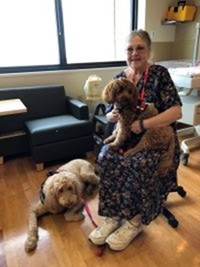 Grace, and newly certified cockapoo, Cooper. A certified therapy dog owner for three years, Huddleston and 6-year-old Sophie are regulars at the hospital while Cooper, just 14 months, is a new face. Sophie Grace and Coooper are treat motivated and their owner also distributes a few wrapped treats to each staff member who crosses their path during their weekly visits to the hospital.
As someone who regularly sees the positive effect her two furry friends have on the hospital staff and patients, Huddleston encourages others with a certified therapy dog to sign up through Carle Health Volunteer Services.
“We really need more volunteers. Any size dog will work, and it does not matter what breed as long as they complete the training to be a certified therapy dog,” she said.
Patients can request a visit from a therapy dog to provide comfort, remind them of their pets at home, help provide a distraction and even provide a mental health boost, Heather L. Gray, PTA, CBIS, said. As the inpatient rehab admission coordinator and pet therapy co-coordinator at Carle Foundation Hospital, she said her favorite way to see therapy dogs in action is during inpatient rehab and outpatient therapy sessions.
“For example, patients work on balance as they walk a therapy dog on a leash, or patients practice fine motor and gross motor tasks when throwing a ball or giving a treat to a therapy dog. The therapy dogs also provide opportunities for some patients to practice voice command and memory tasks (reciting name, type and color of the therapy dog),” Gray said.
Retired as director of Business and Operations from Krannert Center for Performing Arts, Huddleston said she was thinking about owning a therapy dog when her cousin in Florida informed her she had a 9-week-old golden doodle for her. And the rest is history. She started volunteering with a therapy dog three years ago.
Cooper joined the effort when Huddleston received a photo of him from her daughter. The owner sought someone new to be his owner. “My daughter sent me a picture and that was it,” she said.
When it comes to visiting the hospital, Huddleston does not stay too long in any one spot with the well-groomed dogs who wear therapy vests. As a precaution, young Cooper also wears a small dog diaper, until he’s more reliably trained. Each dog receives a treat for doing well and Huddleston brings along her own collapsible water dishes when Cooper and Sophie need a drink after all those treats.
Eric Toliver, Auxiliary and Volunteer Services, director said, “Therapy dogs make a big impact on the lives of both our patients and team members at Carle. We often hear how visits brighten spirits, and we receive requests for these furry volunteers to help with several unique scenarios, ranging from patients who need some positive vibes to employee teams who are grieving a recent loss. We’re grateful for all the certified pet therapy dogs and handlers we have throughout the health system and the difference they make each day.”
Huddleston took advantage of the Canine Good Citizen classes offered in Champaign where Sophie and Cooper both learned positive behaviors being around people, around other dogs and around medical settings. Young Cooper also took a basic behavior class. In the Good Citizen coursework, dogs learn how to be around medical equipment, including wheelchairs, and how to work with the owner and react when there are sudden noises. Successful completion of the classes and tests takes about 16 weeks (classes meet once a week), and the owner receives an American Kennel Club certificate after passing the Good Citizen Test. Huddleston also found a dog trainer in the area who does not charge for the three-part Pet Therapy test.
“You have to h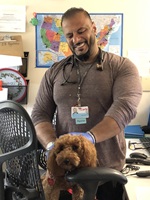 ave the dog prepared before you take the certified therapy dog test,” she said.
Volunteering at Carle with a therapy dog is very flexible not only in the amount of time you want to spend, but also when in the day. There is also a need for therapy dogs at Carle Health locations in Hoopeston, Rantoul, Mattoon, Monticello, Mahomet, Danville and Champaign.
To learn more, contact Volunteer Services at volunteer.services@carle.com or call (217) 383-6701.
Categories: Culture of Quality, Community