
A dollhouse, puppets, stuffed animals, board games and a sandbox.
What might look like ordinary playthings to most people are, in fact, essential tools for Carle Health experts to gain insight into the behavioral health needs of young patients.
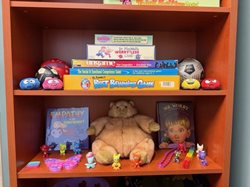 These items support play therapy: a form of treatment where trained therapists incorporate play to help kids and adolescents address behavioral challenges and support healthy development.
“It is a neurodevelopmentally sensitive approach to working with children,” Brooke DiBello, a Carle Health Licensed Clinical Professional Counselor (LCPC) and Registered Play Therapist (RPT™), said. “Play is necessary because it is how kids communicate, and we are meeting them at their developmental level.”
Play therapists across the Carle Health system support children and families using the power of play to understand trauma, guide treatment and strengthen family communication.

Experts often say play therapy is to kids what counseling is to adults.
“Play is the natural language of children,” Melanie Bailey, LCPC, RPT, Carle Health psychotherapist said. “They may not have the words for what might hurt, scare or embarrass them, but their play brings those feelings out so we can see and understand what they’re experiencing.”
A provider may refer a patient to play therapy if they’ve experienced trauma, are adjusting to major life changes such as a parent’s divorce, are grieving a loss or are facing challenges at home or school.
Play therapists tailor each session to how the patient is thinking, feeling and behaving, using structuring, tracking and reflection to closely observe how they interact with toys.
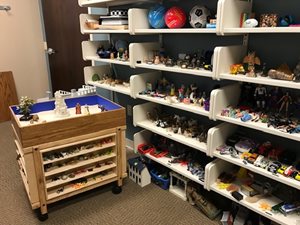 “Those toys might be houses and other structures, people and animals, trees and rocks, all the way up to cultural and religious items,” Lori Osborne, LCSW, RPT, Carle Health mental health clinician said. “It is all on display, so they can grab what they need according to how they want to express themselves. Some characters look friendly and some may look a little rougher than others because you want them to be able to express that.”
Each toy has a purpose, which Bailey says helps visualize specific themes.
“During that time, we are giving language to the things they are doing to help build that bridge between what they feel and what they may not know how to express,” Bailey said.
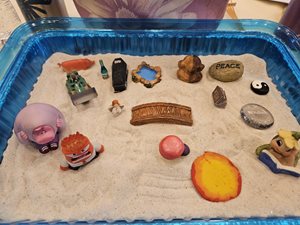
Toy themes include: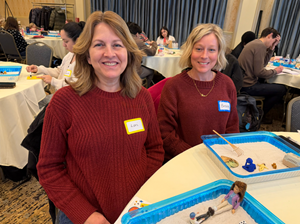 guys - these guys are evil.’ We listen to and observe that to better understand what they may be experiencing,” DiBello said. “This is their space, and the play can help them engage and respond to our conversation.”
“It takes another level of verbal ability to process and express trauma, grief or change. When they play, it is just more natural,” Osborne added.
Play therapists say parental involvement is hugely important, adding that play therapy can help establish trust, comfort and communication.
When supporting a young patient, clinicians also schedule guardian-only sessions at least once per month where guardians can discuss updates and changes in behavior directly with the play therapist.
“We aren’t just treating the child – we’re treating the whole family,” Bailey said. “A child cannot expect to make changes if their environment isn’t changing. That system must change with them.”
Becoming a Registered Play Therapist™ involves several rigorous prerequisites including an active clinical license, specific coursework, and hundreds of hours of play therapy practice and implementation. Currently, there are just 44 play therapists registered to practice in all of Illinois.
 DiBello works to train the next generation of play therapists through a clerkship offered to third-year medical students. In addition, she volunteers for the Illinois Association for Play Therapy (IL-APT), which is currently exploring opportunities to expand training throughout the state.
“There is a tremendous need for this service, and our team is deeply committed to supporting children and their families. Play therapy is a powerful, effective tool in behavioral health, and we’re excited to see its role continue to expand in child and adolescent mental healthcare,” DiBello said.
“We are giving kids a chance to express themselves when they otherwise couldn’t – and that is so valuable,” Osborne added.
Play therapy is an integral component of the comprehensive continuum of pediatric healthcare services available across the Carle Health system.
To learn more about play therapy, child psychology and other behavioral health services offered at Carle Health, visit Carle.org.
What might look like ordinary playthings to most people are, in fact, essential tools for Carle Health experts to gain insight into the behavioral health needs of young patients.
These items support play therapy: a form of treatment where trained therapists incorporate play to help kids and adolescents address behavioral challenges and support healthy development.“It is a neurodevelopmentally sensitive approach to working with children,” Brooke DiBello, a Carle Health Licensed Clinical Professional Counselor (LCPC) and Registered Play Therapist (RPT™), said. “Play is necessary because it is how kids communicate, and we are meeting them at their developmental level.”
Play therapists across the Carle Health system support children and families using the power of play to understand trauma, guide treatment and strengthen family communication.
Experts often say play therapy is to kids what counseling is to adults.
“Play is the natural language of children,” Melanie Bailey, LCPC, RPT, Carle Health psychotherapist said. “They may not have the words for what might hurt, scare or embarrass them, but their play brings those feelings out so we can see and understand what they’re experiencing.”
A provider may refer a patient to play therapy if they’ve experienced trauma, are adjusting to major life changes such as a parent’s divorce, are grieving a loss or are facing challenges at home or school.
Play therapists tailor each session to how the patient is thinking, feeling and behaving, using structuring, tracking and reflection to closely observe how they interact with toys.
“Those toys might be houses and other structures, people and animals, trees and rocks, all the way up to cultural and religious items,” Lori Osborne, LCSW, RPT, Carle Health mental health clinician said. “It is all on display, so they can grab what they need according to how they want to express themselves. Some characters look friendly and some may look a little rougher than others because you want them to be able to express that.”Each toy has a purpose, which Bailey says helps visualize specific themes.
“During that time, we are giving language to the things they are doing to help build that bridge between what they feel and what they may not know how to express,” Bailey said.
Toy themes include:
- Real-life and Nurturing toys, such as a doll, baby bottle or happy puppet
- Acting out or Aggressive toys, like toy soldiers, foam swords and handcuffs, and
- Creative Expression / Emotional Release toys, such as sand, craft materials and musical instruments.
guys - these guys are evil.’ We listen to and observe that to better understand what they may be experiencing,” DiBello said. “This is their space, and the play can help them engage and respond to our conversation.”“It takes another level of verbal ability to process and express trauma, grief or change. When they play, it is just more natural,” Osborne added.
Play therapists say parental involvement is hugely important, adding that play therapy can help establish trust, comfort and communication.
When supporting a young patient, clinicians also schedule guardian-only sessions at least once per month where guardians can discuss updates and changes in behavior directly with the play therapist.
“We aren’t just treating the child – we’re treating the whole family,” Bailey said. “A child cannot expect to make changes if their environment isn’t changing. That system must change with them.”
Becoming a Registered Play Therapist™ involves several rigorous prerequisites including an active clinical license, specific coursework, and hundreds of hours of play therapy practice and implementation. Currently, there are just 44 play therapists registered to practice in all of Illinois.
DiBello works to train the next generation of play therapists through a clerkship offered to third-year medical students. In addition, she volunteers for the Illinois Association for Play Therapy (IL-APT), which is currently exploring opportunities to expand training throughout the state.“There is a tremendous need for this service, and our team is deeply committed to supporting children and their families. Play therapy is a powerful, effective tool in behavioral health, and we’re excited to see its role continue to expand in child and adolescent mental healthcare,” DiBello said.
“We are giving kids a chance to express themselves when they otherwise couldn’t – and that is so valuable,” Osborne added.
Play therapy is an integral component of the comprehensive continuum of pediatric healthcare services available across the Carle Health system.
To learn more about play therapy, child psychology and other behavioral health services offered at Carle Health, visit Carle.org.
Categories: Redefining Healthcare
Tags: adolescent., behavioral, bloomington, carle, champaign, health, health., normal, pediatrics, play, therapy, urbana