
Tara DeBerry first noticed her vision was deteriorating when everyday activities became increasingly difficult.
Driving at night was nearly impossible, and as a schoolteacher, she found it much harder to see the classroom whiteboard.
After extensive testing, eye specialists diagnosed DeBerry with Retinis Pigmentosa – a disorder that causes light-sensitive cells in the eyes to break down slowly, resulting in low vision and progressive vision loss.
“I put off addressing it for such a long time,” DeBerry said. “Once it affected my job, I knew I really needed to seek assistance.”
Specialists referred DeBerry to Occupational Therapy at Carle Foundation Hospital (CFH), where she began working with Carle Health Occupational Therapist and Certified Low Vision Therapist Teresa Scott, OTD, CLVT. Together, they explored a range of tools and resources, many of which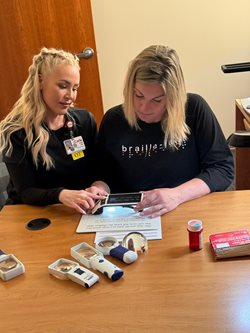 were new to DeBerry.
“We used a comprehensive approach and addressed the physical, cognitive and emotional aspects of vision loss together,” Scott said.
Scott introduced DeBerry to several helpful devices including a portable, handheld Closed-Circuit Television, or CCTV, which uses a camera to magnify and enhance objects onto a monitor.
“It allows me to read my mail again – I couldn’t see print on paper anymore,” DeBerry said. “It also helps me read menus at restaurants so someone else doesn’t have to.”
Scott also educated DeBerry on ways to manage glare sensitivity by exploring different types of tinted lenses that improve contrast in the environment and decrease glare on the eyes.
“We found that she managed glare better using a reddish-orange pair of sunglasses in the sun, and yellow tinted lenses to improve contrast as it became darker. That helped her tolerate different types of lighting in various environments,” Scott said.
Finally, they discussed a variety of helpful home adaptations to manage vision loss which included: incorporating large-font and high contrast or textured labels to assist with operating kitchen appliances, organizational strategies for dressing and closet arrangement, and using a personalized address stamp for writing and sending mail.
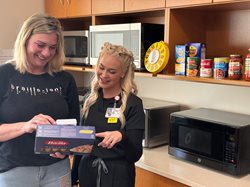 “I had none of these items before and was really struggling to teach myself and navigate on my own,” DeBerry said. “They were all miracles.”
In addition to the tools, Scott helped get DeBerry in contact with a variety of lifechanging resources. She meets with a vocational rehabilitation specialist every other week, practices reading and writing Braille twice per week, works with an orientation & mobility trainer to help with moving around, and even has specialty transportation service for long distance needs.
She is also using a special computer program that she says will only grow more helpful as her vision continues to weaken.
“At one point, I had no independence left. I couldn’t drive and was just stuck unless someone was with me,” DeBerry said. “Without Teresa, I wouldn’t have known who to contact or where to go. She was amazing – she listened, answered all my questions, explained each resource and immediately responded if I ever got stuck. She checked in on me a lot too.”
“Many patients with low vision are told nothing can be done and hesitate to seek care,” Scott said. “We want them to know there is hope - occupational therapy can help people regain independence by maximizing their remaining vision. Tara’s optimism and willingness to try new approaches helped her achieve her goals.”
DeBerry continues to do the things she loves. She frequently attends sporting events like basketball and softball games, and loves eating out with friends and family. She also runs a t-shirt printing business.
“My assistive technology team even sent an engineer to help redesign my t-shirt press so I can make designs and press shirts without issue,” DeBerry said.
DeBerry describes her experience with Scott as life-changing, encouraging anyone dealing with low vision to seek assistance.
“I should’ve done this a long time ago but was stubborn – it is absolute freedom,” DeBerry said. “Teresa is just so welcoming, understanding and amazing.”
“Low vision is a big life change, and we are here to navigate it with our patients, together.” Scott said.
To learn more about physical, occupational, and other therapy services offered throughout the Carle Health system, please visit Carle.org.
Driving at night was nearly impossible, and as a schoolteacher, she found it much harder to see the classroom whiteboard.
After extensive testing, eye specialists diagnosed DeBerry with Retinis Pigmentosa – a disorder that causes light-sensitive cells in the eyes to break down slowly, resulting in low vision and progressive vision loss.
“I put off addressing it for such a long time,” DeBerry said. “Once it affected my job, I knew I really needed to seek assistance.”
Specialists referred DeBerry to Occupational Therapy at Carle Foundation Hospital (CFH), where she began working with Carle Health Occupational Therapist and Certified Low Vision Therapist Teresa Scott, OTD, CLVT. Together, they explored a range of tools and resources, many of which
were new to DeBerry.“We used a comprehensive approach and addressed the physical, cognitive and emotional aspects of vision loss together,” Scott said.
Scott introduced DeBerry to several helpful devices including a portable, handheld Closed-Circuit Television, or CCTV, which uses a camera to magnify and enhance objects onto a monitor.
“It allows me to read my mail again – I couldn’t see print on paper anymore,” DeBerry said. “It also helps me read menus at restaurants so someone else doesn’t have to.”
Scott also educated DeBerry on ways to manage glare sensitivity by exploring different types of tinted lenses that improve contrast in the environment and decrease glare on the eyes.
“We found that she managed glare better using a reddish-orange pair of sunglasses in the sun, and yellow tinted lenses to improve contrast as it became darker. That helped her tolerate different types of lighting in various environments,” Scott said.
Finally, they discussed a variety of helpful home adaptations to manage vision loss which included: incorporating large-font and high contrast or textured labels to assist with operating kitchen appliances, organizational strategies for dressing and closet arrangement, and using a personalized address stamp for writing and sending mail.
“I had none of these items before and was really struggling to teach myself and navigate on my own,” DeBerry said. “They were all miracles.”In addition to the tools, Scott helped get DeBerry in contact with a variety of lifechanging resources. She meets with a vocational rehabilitation specialist every other week, practices reading and writing Braille twice per week, works with an orientation & mobility trainer to help with moving around, and even has specialty transportation service for long distance needs.
She is also using a special computer program that she says will only grow more helpful as her vision continues to weaken.
“At one point, I had no independence left. I couldn’t drive and was just stuck unless someone was with me,” DeBerry said. “Without Teresa, I wouldn’t have known who to contact or where to go. She was amazing – she listened, answered all my questions, explained each resource and immediately responded if I ever got stuck. She checked in on me a lot too.”
“Many patients with low vision are told nothing can be done and hesitate to seek care,” Scott said. “We want them to know there is hope - occupational therapy can help people regain independence by maximizing their remaining vision. Tara’s optimism and willingness to try new approaches helped her achieve her goals.”
DeBerry continues to do the things she loves. She frequently attends sporting events like basketball and softball games, and loves eating out with friends and family. She also runs a t-shirt printing
business.“My assistive technology team even sent an engineer to help redesign my t-shirt press so I can make designs and press shirts without issue,” DeBerry said.
DeBerry describes her experience with Scott as life-changing, encouraging anyone dealing with low vision to seek assistance.
“I should’ve done this a long time ago but was stubborn – it is absolute freedom,” DeBerry said. “Teresa is just so welcoming, understanding and amazing.”
“Low vision is a big life change, and we are here to navigate it with our patients, together.” Scott said.
To learn more about physical, occupational, and other therapy services offered throughout the Carle Health system, please visit Carle.org.
Categories: Culture of Quality
Tags: blindness, carle, cctv, foundation, hospital, low, occupational, pigmentosa, retinis, sight, therapy, vision